

The Ayur Healthcare SEO case study offers a practical look at what can happen when SEO focuses on more than rankings and backlinks. While SEO campaigns are often measured through traffic, keyword positions, and other numbers, the more useful question is what actually changed underneath those results.
Over the first 90 days, NS Digi worked across technical SEO, on-page optimization, local SEO, Google Business Profile optimization, content optimization, link building, and community engagement. The campaign was—and remains—ongoing, but the first 90 days produced measurable movement across Google Search Console and third-party SEO metrics.
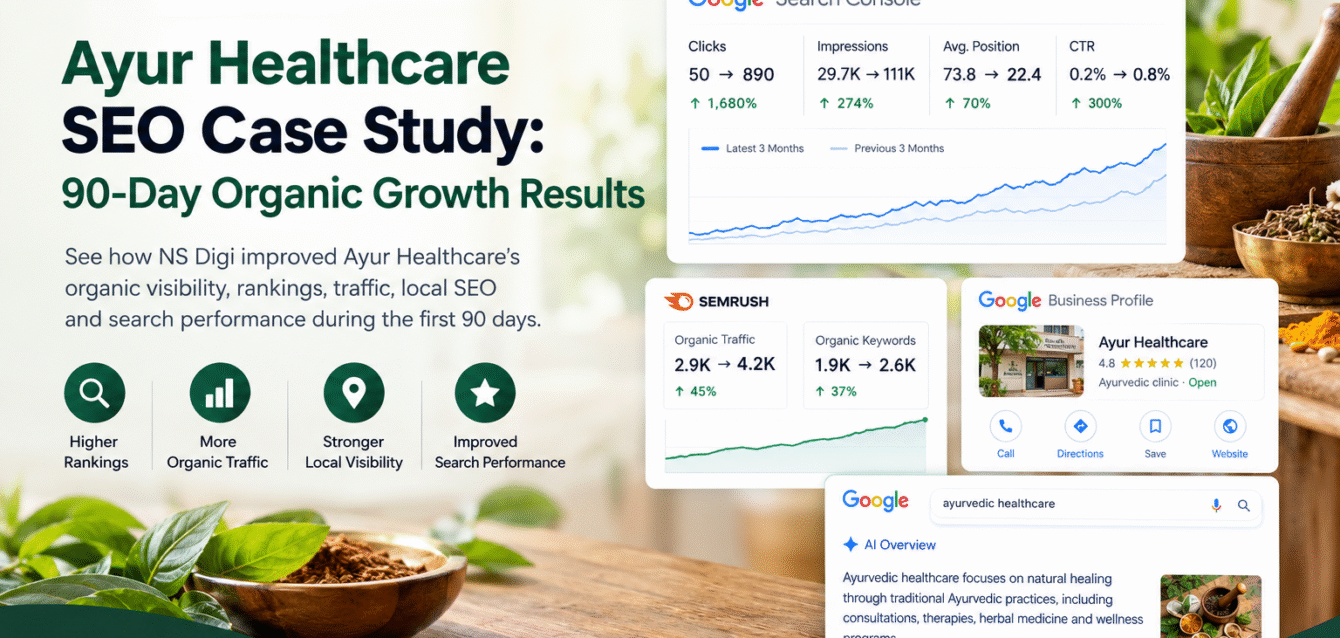
The most visible change came in Google Search Console: clicks increased from 50 to 890, impressions increased from 29.7K to 111K, and average position improved from 73.8 to 22.4 when comparing the previous three months with the latest three months documented in the case study.
At the same time, the website’s reported organic traffic increased from 2.9K to 4.2K, while organic keywords increased from 1.9K to 2.6K.
This article examines how these changes were made by NS Digi achieved what the numbers actually tell us, and what the project suggests about SEO as search continues to evolve toward AI-powered experiences.
What was the main SEO challenge?
Ayur Healthcare needed to improve organic visibility while addressing technical, on-page, performance, local SEO, and authority-related limitations. The campaign therefore focused on strengthening the website as a whole rather than relying on a single SEO tactic.
Ayur Healthcare SEO Case Study: The Starting Point
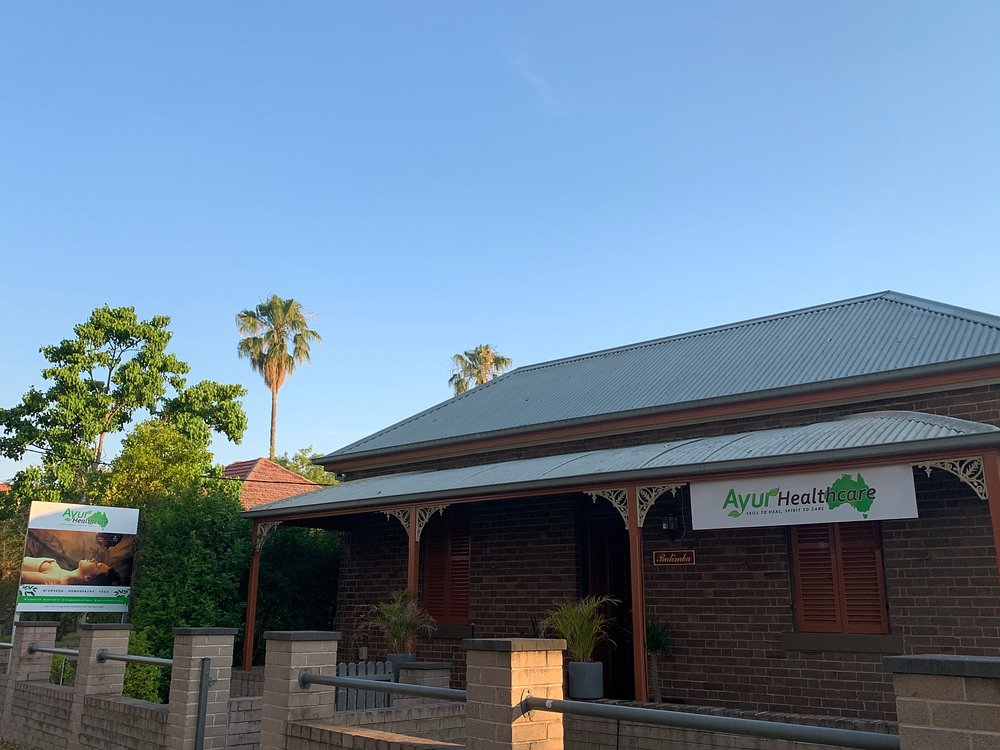
Ayur Healthcare is an Australian Ayurvedic healthcare provider offering services including Ayurvedic consultations, Panchakarma therapy, herbal medicine, massage therapy, and wellness programs.
Because the business operates in healthcare and serves a local audience, visibility has to work on several levels.
A potential customer may search for a specific Ayurvedic service. Another person may search for an Ayurvedic healthcare provider in their area. Someone else may encounter the business through Google Maps or a Google Business Profile.
That means simply increasing the number of keywords ranking in Google is not enough.
The campaign needed to improve the website’s technical foundation, make important pages more relevant to search intent, strengthen local visibility, improve authority, and create more opportunities for qualified users to discover the business.
That broader objective shaped the first 90 days.
Ayur Healthcare SEO Strategy: What Needed to Change?
The initial website analysis identified several areas limiting search performance.
The documented challenges included:
- Low organic visibility
- Technical SEO issues
- Weak website authority
- Slow website performance
- Improper heading structure
- Limited keyword rankings
- On-page SEO improvements
- Opportunities to improve local search visibility
The important point is that these were not isolated problems.
For example, creating more content would not automatically resolve crawlability or indexing issues. Similarly, acquiring backlinks would not fix poorly structured pages or slow performance.
The campaign therefore began with a broader website assessment.
The objective was to identify the highest-impact improvements and establish a stronger foundation before expanding authority and keyword coverage.
Starting Point and Baseline
Before optimization, the case study describes the website as having lower authority metrics, limited keyword visibility, and weaker organic search performance.
The campaign established several measurable baseline figures that make it possible to evaluate progress.
| Metric | Before | Current / Result |
|---|---|---|
| Domain Authority | 22 | 30 |
| Domain Rating | 34 | 42 |
| Authority Score | 24 | 32 |
| Organic Traffic | 2.9K | 4.2K |
| Organic Keywords | 1.9K | 2.6K |
These figures are useful because they show that the project was not limited to one measurement.
There was movement in reported authority metrics, estimated organic traffic, and the number of ranking keywords.
However, third-party metrics such as Domain Authority, Domain Rating, and Authority Score should be interpreted as SEO-tool indicators rather than direct Google ranking factors. Their value in this case is primarily comparative: they help demonstrate how the website’s authority profile changed during the campaign.
The strongest first-party evidence in the case study comes from Google Search Console.
The Strategy Behind the First 90 Days
The campaign used a multi-layered approach rather than treating SEO as a single activity.
The documented services included:
- Technical SEO
- On-page SEO
- Local SEO
- Google Business Profile optimization
- Link building
- Keyword research
- Content optimization
- Performance optimization
- Quora marketing
- Reddit marketing
Each activity addressed a different part of the search journey.
Technical SEO helped establish a better foundation. On-page optimization improved relevance and page structure. Local SEO addressed location-based discovery. Link building supported authority development. Community activity expanded brand visibility beyond the website itself.
That combination is important because sustainable organic growth usually requires several components to work together.
Technical SEO Improvements for Ayur Healthcare
Before focusing heavily on authority and visibility, NS Digi conducted a comprehensive website audit.
The documented technical work included:
- XML sitemap review
- Robots.txt verification
- Crawlability improvements
- Indexing optimization
- URL structure review
- Internal linking improvements
- Image optimization
- Mobile-friendly optimization
- Performance enhancements
These tasks may not always be visible to a website visitor, but they influence how efficiently a search engine can understand and process a website.
A technically strong website also makes later SEO work relted to digital marketing more useful. If important pages are difficult to crawl, poorly structured, or affected by technical problems, additional content and promotion can have less impact than expected.
The Ayur Healthcare campaign therefore treated technical SEO as infrastructure rather than an isolated checklist.
Website Performance Optimization
Website performance was another documented area of concern.
The case study reports that the website had performance issues affecting loading speed and user experience before optimization.
NS Digi subsequently worked on performance improvements with the stated objectives of creating a faster and more responsive website.
The reported SEO impact included:
- Improved website performance
- Better user experience
- Enhanced Core Web Vitals
- A stronger technical SEO foundation
There is an important lesson here.
Performance should not be viewed solely as a ranking exercise. A slow website can also create friction for people who are trying to learn about healthcare services, compare options, find contact information, or take the next step.
SEO and user experience overlap.
Improving the technical experience can therefore support both search accessibility and the people who ultimately use the website.
Heading Structure: A Small Detail With a Larger Role
The audit also identified heading structure problems.
The work included:
- Fixing missing H1 tags
- Correcting heading hierarchy
- Removing duplicate headings
- Improving content structure
This matters because headings provide structure for both readers and search engines.
A well-organized page makes it easier to understand the relationship between the main topic, supporting sections, and specific services.
The result was a more organized content structure with improved keyword relevance, crawlability, and user experience according to the case study.
The broader lesson is simple: SEO improvements are not always complicated.
Sometimes the first step is making an existing page easier to understand.
On-Page SEO: Connecting Pages With Search Intent
After technical improvements, the campaign moved into on-page optimization.
The documented activities included:
- Keyword research
- SEO title optimization
- Meta description optimization
- Content optimization
- Internal linking
- Image ALT tags
- Service-page optimization
- URL optimization
The purpose was to improve the relationship between important pages, target keywords, and user search intent.
Metadata Optimization
SEO titles and meta descriptions were optimized around relevant target keywords and search intent.
Metadata does not operate in isolation, but it is an important part of how pages are presented in search.
Clear titles can help users understand what a page offers before they click. Descriptions can provide additional context about the page.
The goal is not simply to insert keywords.
The goal is to make the search result accurately communicate the page’s purpose.
Building Website Authority
Another major component of the campaign was authority development.
The website started with the following documented authority metrics:
- Domain Authority: 22
- Domain Rating: 34
- Authority Score: 24
The reported current figures were:
- Domain Authority: 30
- Domain Rating: 42
- Authority Score: 32
These changes occurred alongside link-building and other SEO activities.
The campaign focused on acquiring relevant, quality backlinks and strengthening the website’s overall backlink profile.
The case study reports that successfully indexed backlinks contributed to stronger authority signals and supported keyword performance.
It is worth keeping the interpretation measured.
A backlink is not automatically valuable simply because it exists. Relevance, quality, context, indexability, and the overall health of a site’s link profile matter.
That is why the campaign’s focus on relevant and quality backlinks is more meaningful than simply counting the number of links acquired.
Local SEO and Google Business Profile Optimization
For a local healthcare provider, website SEO is only one part of discovery.
Google Business Profile optimization was therefore included in the campaign.
The documented work included:
- Business information optimization
- Category optimization
- Service updates
- Business description enhancement
- Regular Google Posts
- Image updates
- Review monitoring
- Local SEO improvements
The purpose was to improve the completeness and relevance of the business’s local search presence.
This is particularly important for searches where location is part of the user’s intent.
Someone looking for Ayurvedic healthcare services may not begin with a general informational query. They may search for a provider, service, or clinic in a specific location.
A properly maintained Business Profile can help the business appear in relevant local search and Maps experiences.
The campaign therefore treated local visibility as a separate but connected SEO channel.
Ayur Healthcare SEO Results in Google Search Console
One of the most useful parts of the case study is the comparison from Google Search Console.
The documented comparison was between the previous three months and the latest three months.
| Google Search Console Metric | Previous 3 Months | Latest 3 Months |
|---|---|---|
| Clicks | 50 | 890 |
| Impressions | 29.7K | 111K |
| CTR | 0.2% | 0.8% |
| Average Position | 73.8 | 22.4 |
The changes are substantial.
Clicks increased from 50 to 890.
Impressions increased from 29.7K to 111K.
CTR increased from 0.2% to 0.8%.
Average position improved from 73.8 to 22.4.
These metrics tell slightly different stories.
Impressions show expanding visibility
The increase from 29.7K to 111K impressions indicates that the website appeared in Google’s search results much more frequently during the later period.
That is important because impressions represent opportunities for users to see the website.
Clicks show increased search engagement
Clicks rose from 50 to 890.
This suggests that the increased visibility was accompanied by considerably more visits from Google Search during the comparison period.
Average position shows movement toward stronger rankings
Average position improved from 73.8 to 22.4.
This does not mean every keyword reached position 22.4. Average position is an aggregate metric across the queries and results represented in Search Console.
Still, the change indicates a substantial improvement Ayur Healthcare SEO case study in the website’s overall search positioning across the measured period.
CTR provides another layer of context
CTR increased from 0.2% to 0.8%.
Although the percentage remains relatively modest, the direction of change is important when considered alongside the increase in impressions and clicks.
Together, these metrics show that the campaign was not simply producing more impressions without engagement.
Organic Keyword Growth
The case study also reports growth in the number of organic keywords.
Organic keywords increased from 1.9K to 2.6K.
That represents an increase of approximately 700 tracked keywords in the documented comparison.
Again, the significance is broader than the number itself.
A growing keyword footprint can indicate that a website is becoming visible for a wider range of relevant searches.
For an Ayurvedic healthcare provider, that broader footprint can include service-related, informational, and locally relevant searches.
The objective should not be to rank for every possible keyword.
The more meaningful goal is to build visibility around queries that have a genuine connection to the services and information a business provides.
What Changed—and Why It Matters
The first 90 days produced improvements across several different layers:
Technical: The website received technical and performance optimization.
On-page: Important pages received improved titles, descriptions, content, structure, internal linking, and image optimization.
Authority: Reported authority metrics increased.
Organic visibility: Search Console showed major growth in impressions and clicks.
Keyword coverage: Organic keywords increased from 1.9K to 2.6K.
Local search: Google Business Profile optimization strengthened the local-search component.
Brand visibility: Quora and Reddit activities expanded community-facing visibility.
The key takeaway is that no single activity explains the entire project.
These results were achieved through a campaign where the SEO team addressed several interconnected areas, including technical SEO, on-page optimization, local SEO, and authority building.
That is why the case study is more useful as a process example than as a promise that one specific tactic will produce the same outcome for another business.
What This Case Study Teaches About SEO in 2026
SEO in 2026 is increasingly about building a website that can be understood, trusted, crawled, and used effectively.
Google’s current documentation continues to emphasize technical accessibility, useful content, structured information, and compliance with Search policies. Google has also published specific guidance around generative AI features in Search, while noting that established SEO fundamentals remain relevant.
The Ayur Healthcare project reflects several of those durable principles.
1. Technical SEO still matters
A website cannot benefit fully from Ayur Healthcare SEO case study content and authority work if important pages have technical obstacles.
Crawlability, indexing, mobile usability, page performance, internal linking, and clear structure remain practical foundations.
2. Content needs a reason to exist
Content should answer real questions, explain services clearly, or provide useful information.
Creating pages simply because a keyword has search volume is a weak long-term strategy.
3. Authority needs context
Links can contribute to authority, but quantity alone does not explain quality.
The focus should remain on relevant, trustworthy sources and useful information rather than mechanically accumulating backlinks.
4. Local businesses need local signals
For a healthcare provider serving a specific market, website optimization and Business Profile optimization work together.
Local SEO is not simply adding a city name to a page.
It involves making business information clear and consistent and giving search systems useful signals about the organization and its services.
SEO Meets AI Search: Why Visibility Is Changing
Search behavior is expanding beyond traditional blue links.
Google now provides AI-powered experiences such as AI Overviews and AI Mode, while other platforms use generative systems and answer-engine approaches to respond directly to questions.
Google’s documentation explains that AI Overviews and AI Mode can use web sources when generating responses. It also continues to emphasize that pages need to be crawlable and indexable for Google Search.
That creates a broader concept of visibility.
A business may want to be:
- visible in traditional organic results
- visible in local search
- understandable as an entity
- discoverable for relevant questions
- represented accurately in search features
- referenced by AI-powered search experiences
But AI visibility should not be treated as a shortcut.
There is no reliable formula that guarantees a page will be cited by ChatGPT, Gemini, Google AI Overviews, or another answer engine.
Instead, the fundamentals remain Ayur Healthcare SEO case study familiar: useful information, clear entities, strong topical relevance, original experience, accessible pages, trustworthy signals, and good information architecture.
Google’s 2026 documentation specifically warns against treating generative-AI optimization as a separate magic system and continues to connect generative search visibility with established SEO practices.
For a healthcare business, this makes first-hand and trustworthy information particularly important.
A page explaining a service should clearly communicate what the service is, who it is for, what the provider offers, and relevant factual details.
The easier information is to understand, the easier it becomes for search systems—and people—to interpret.
What Businesses Should Prepare for in 2027
Nobody can accurately describe Google’s exact ranking systems a year in advance.
A better approach is to prepare around principles that are likely to remain useful regardless of individual algorithm changes.
Build first-party expertise
Original experiences, documented projects, expert explanations, and genuine business knowledge are difficult to replace with generic content.
A case study like Ayur Healthcare’s provides something a generic SEO article cannot: a documented example of work, measurements, process, and outcomes.
Strengthen entity clarity
Businesses should make it obvious who they are, what they do, where they operate, and which services they provide.
This applies across the website, local profiles, business information, and other legitimate online references.
Publish content with a clear purpose
Instead of producing dozens of pages of Ayur Healthcare SEO case study that say roughly the same thing, businesses should focus on content that solves specific problems.
Google’s current spam documentation specifically warns against scaled content created primarily to manipulate search rankings rather than help users.
Keep technical SEO healthy
Technical SEO should not be treated as a one-time project.
Websites change. Templates change. URLs change. New pages are published. Tracking systems change.
Regular technical monitoring remains important.
Earn relevant links
High-quality links can support authority, but the objective should be relevance and credibility rather than volume alone.
The same principle applies to digital PR and outreach.
Improve the user journey
Organic traffic has limited business value if visitors cannot understand the service or take an appropriate next step.
SEO should therefore connect with conversion-focused website improvements.
Use structured data appropriately
Structured data can help Google understand certain types of content and entities, where supported. Google continues to document structured-data features and requirements.
It should be used accurately rather than as a shortcut for rankings.
Prepare for multiple search interfaces
Traditional results, Maps, AI Overviews, AI Mode, video, images, and other search experiences can coexist.
Businesses should therefore think about search visibility as a broader ecosystem rather than one ranking position.
Key Takeaways From the Ayur Healthcare SEO Campaign
- SEO improvements work best as a connected system. Technical, on-page, local, content, and authority work can reinforce one another.
- The foundation matters. Crawlability, indexing, structure, performance, and mobile experience were addressed before broader growth efforts.
- Search Console provides valuable first-party evidence. The documented increase from 50 to 890 clicks and 29.7K to 111K impressions provides direct evidence of increased Google Search visibility.
- Keyword growth is useful when it reflects relevant visibility. The increase from 1.9K to 2.6K organic keywords shows a broader search footprint.
- Local SEO matters for local healthcare providers. Google Business Profile optimization was an important part of the campaign.
- Authority development takes more than one tactic. Link building was combined with content and community activities.
- AI search does not replace SEO fundamentals. Strong technical foundations, useful content, entity clarity, relevance, and trustworthy information remain important.
- The campaign is still ongoing. The reported 90-day results represent progress rather than a final endpoint.
FAQ
What was the main goal of the Ayur Healthcare SEO case study campaign?
The campaign focused on improving organic visibility, keyword rankings, technical SEO, website performance, authority, local visibility, and qualified organic traffic.
How much did Ayur Healthcare’s Google Search clicks increase?
According to the case study’s Google Search Console comparison, clicks increased from 50 to 890 between the previous three-month period and the latest three-month period.
Did organic impressions increase?
Yes. Impressions increased from 29.7K to 111K in the documented Search Console comparison.
What happened to average search position?
The reported average position improved from 73.8 to 22.4.
Did the website gain more organic keywords?
Yes. The case study reports an increase from 1.9K to 2.6K organic keywords.
Was local SEO part of the campaign?
Yes. The campaign included Google Business Profile optimization, business information updates, category optimization, service updates, posts, image updates, review monitoring, and local SEO improvements.
Did the campaign include AI search visibility?
Yes. The case study reports that Ayur Healthcare appeared in Google AI Overview for relevant Ayurvedic healthcare searches. This should be understood as an observed result from the documented campaign, not as a guarantee that the same outcome will occur for every website.
Conclusion : Ayur Healthcare SEO case study
The first 90 days of the Ayur Healthcare SEO campaign show why organic growth is rarely the result of one isolated optimization.
The project started with technical and on-page limitations, lower authority metrics, limited keyword visibility, performance concerns, and opportunities in local search. NS Digi approached those issues through a combination of technical SEO, on-page optimization, performance improvements, local SEO, Google Business Profile work, link building, content optimization, and community engagement.
The documented results show meaningful movement.
Google Search clicks increased from 50 to 890, impressions rose from 29.7K to 111K, CTR improved from 0.2% to 0.8%, and average position improved from 73.8 to 22.4. The case study also reports growth in organic traffic, organic keywords, and authority metrics.
Just as importantly, the campaign remains ongoing.
The AIApply case study highlights the SEO work completed for Ayur Healthcare and the significant improvements achieved during the campaign. From technical SEO and on-page optimization to local SEO, authority building, and search visibility, the focused strategy delivered measurable growth across organic traffic, keyword rankings, impressions, clicks, and overall search performance.
For businesses planning their SEO strategy through 2026 and into 2027, the broader lesson is to build something that deserves to be visible: technically accessible pages, useful information, clear services, strong local signals, relevant authority, original Ayur Healthcare SEO case study experience, and a website that serves real users.
Search is changing, including through AI-powered experiences. The fundamentals are changing more slowly.
That is where the Ayur Healthcare project provides its most useful lesson—and where the work documented by NS Digi demonstrates how a structured SEO process can turn a collection of website issues into measurable search-performance progress.